

The hardest people decisions are rarely about performance alone. They're about performance plus trust.
I've seen some founders keep high performers around because "they get results." And I've seen others keep trusted people around because "they've been with us forever."
Both mistakes are expensive.
The Framework
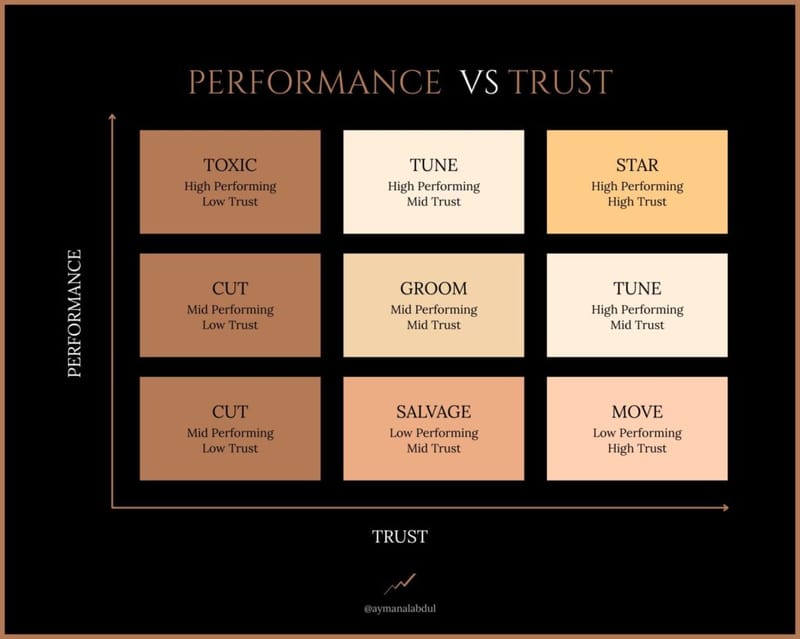
Here's the framework I use:
- High performance + High trust = Star. These are the people you build around. Give them more responsibility. Give them leverage. Keep them close.
- High performance + Mid trust = Tune. The output is there, but something still needs work. Usually communication, consistency, or ownership. Worth developing.
- High performance + Low trust = Toxic. Toxic high performers are the most expensive people in your company. They may hit numbers, but they drain the team. They create politics, fear, and inconsistency.
- Low performance + Mid trust = Salvage. If the character is there, it may be a role issue, a management issue, or a training issue. Diagnose before you decide.
- Low performance + Low trust = Cut. No performance and no trust is the clearest signal on the board.
Everything else should be a coaching moment.
Trust Compounds
Trust makes performance sustainable.
If someone hits the number but breaks the culture, you didn't win. You just borrowed results and paid for them with team health.
Many founders get this wrong because they only ask: "Are they performing?"
The better question is: "What happens to the team if we keep them?"
The Bottom Line
Performance matters. But trust is what determines whether performance compounds or corrodes.
That's why the best teams aren't built with talent alone. They're built with talent you can trust. When you're scaling your business, getting this balance right becomes even more critical.
If you're making the most critical hire for your team, don't just ask if they can perform. Ask if they can be trusted.